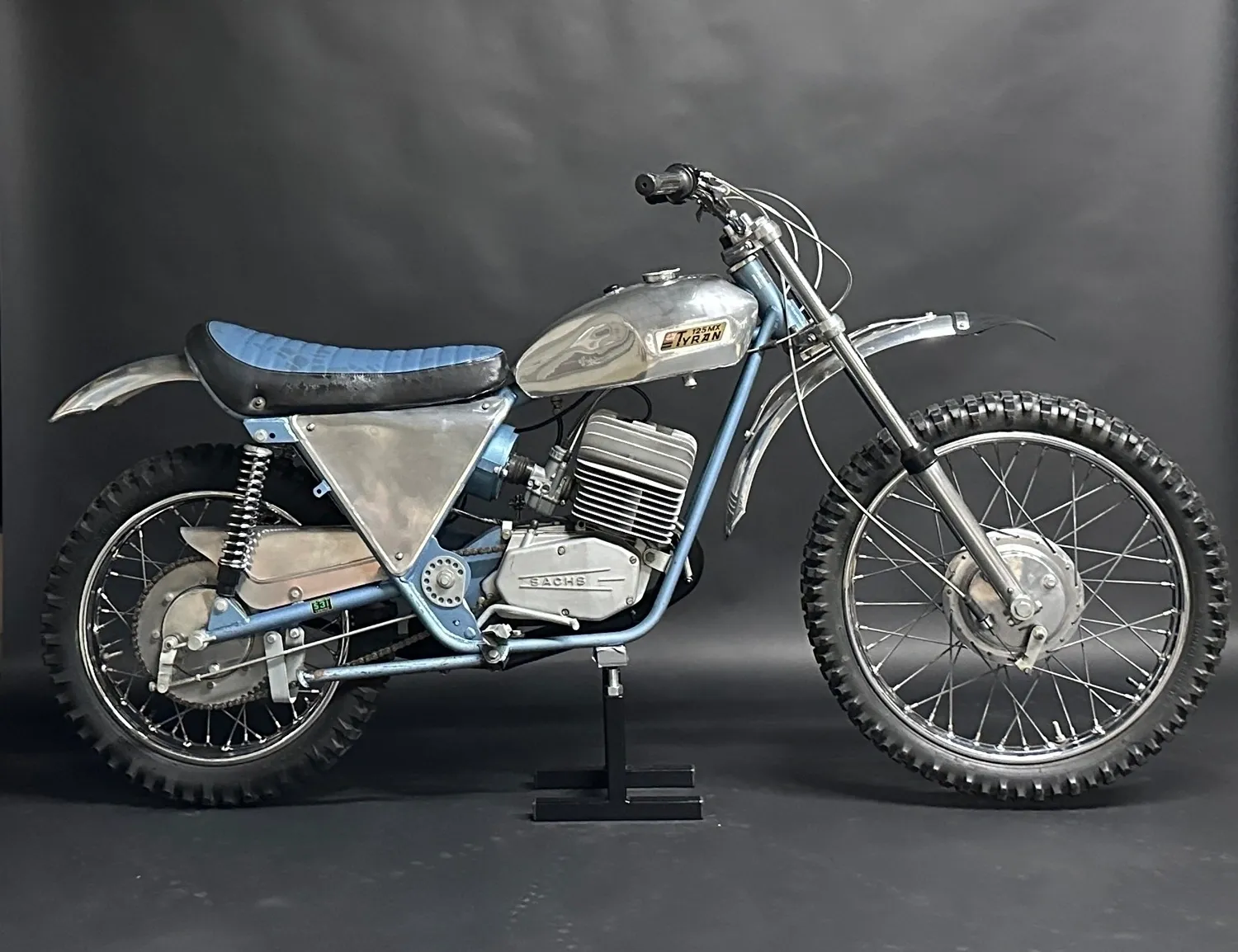
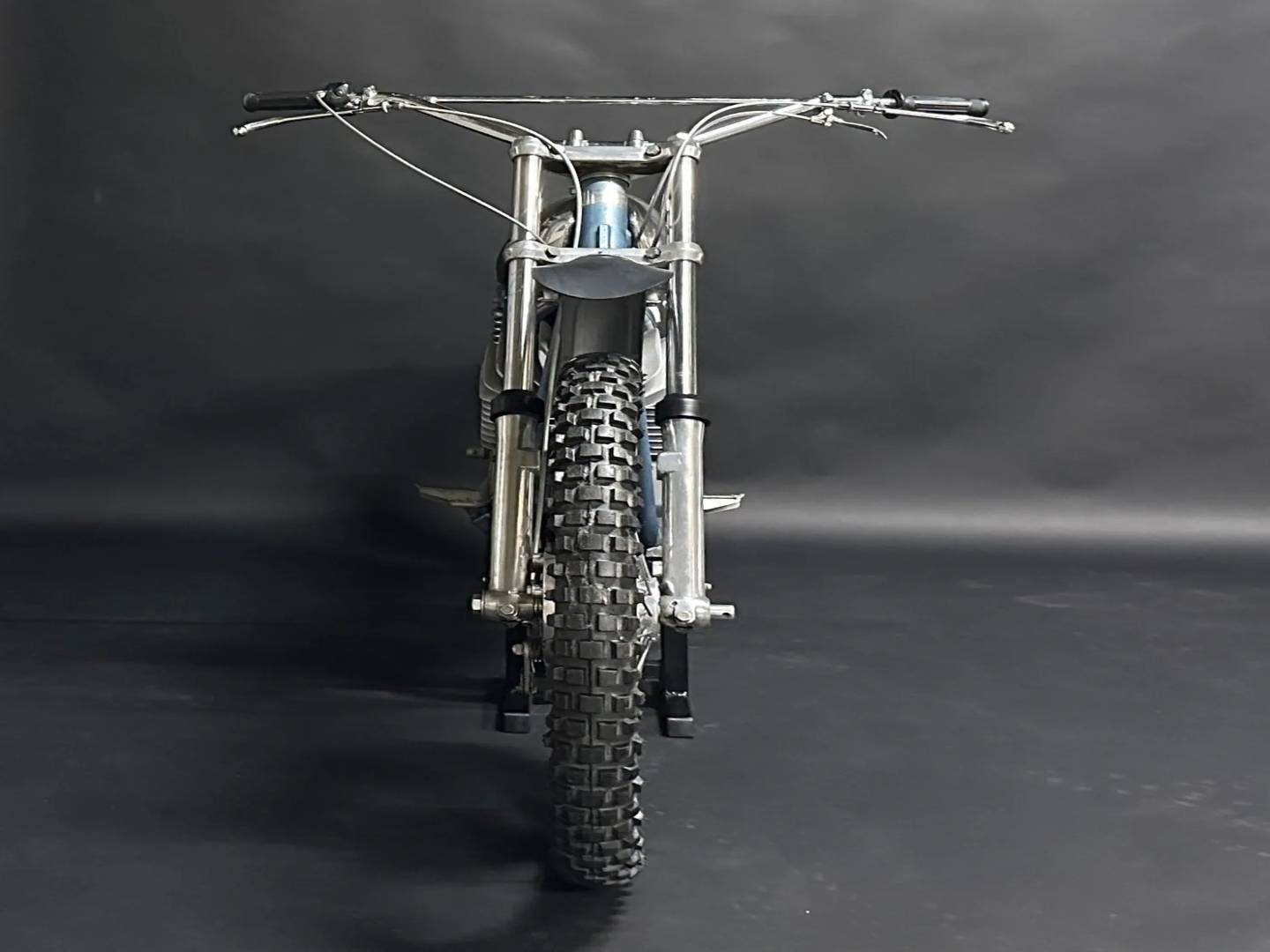
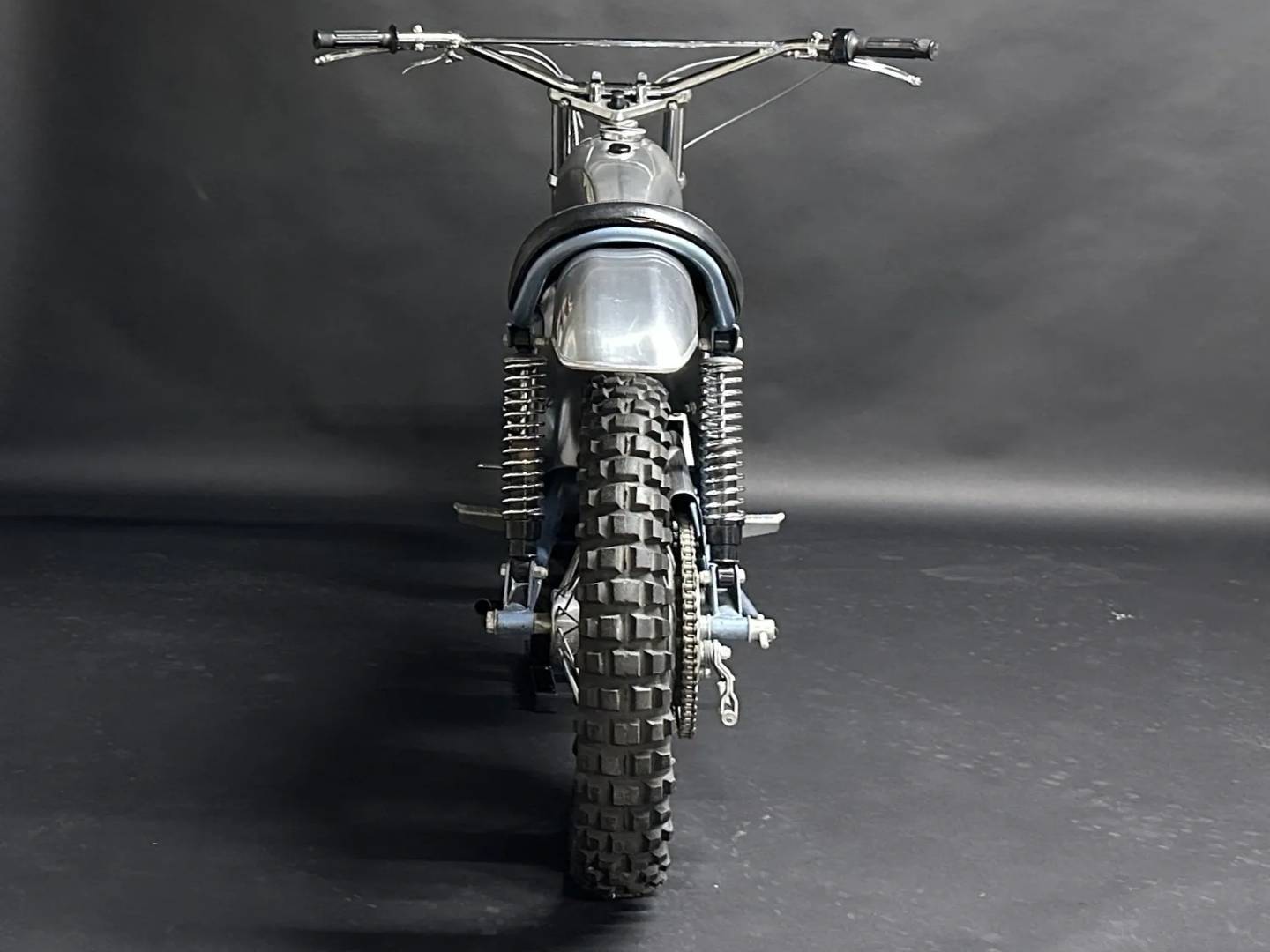
1974 Tyran 125 MX
Model Information
Company History:
Incorporated in the 1950’s W.E. Wassell Ltd. sold add-on and replacement parts for British motorcycles. By the 1960’s the company was operating out of a 67,000 sq ft facility in Staffordshire England with eight full-time sales reps facilitating the European, Australian and American markets. Wassell became so big that they we're comparable to a Parts Unlimited of today.
Although Wassell sold hundreds of components, they were known for high quality Wassell branded parts including beautiful alloy fuel tanks and fenders. They also began building frame kits for the popular BSA Bantam 175 two stroke which became so successful that with the help of Jim Lee and Pete Edmondson (see 1971 Dalesman 125 Moto-Cross Model Info), around 1973 Wassell developed their own Sachs powered 125 trials and 125 motocross bikes.
Wassell awarded US distribution rights of the Antelope trials model to Penton who renamed it the Mudlark. Interestingly, US distribution rights for the motocross model went to Mitsubishi International the massive Japanese conglomerate with distribution based in South Hackensack NJ. Although Mitsubishi was manufacturing cars at the time, they wanted to capitalize on the booming US off-road motorcycle market but didn't have a motorcycle manufacturing plant in the US. Mitsubishi ordered several hundred Wassel 125 motocross models and rebranded them with the Tyran name. At the peak of their motorcycle sales, Wassell managed to manufacture 2.5 machines per day with a motorcycle production staff consisting of three people!
Despite the excitement, the introduction of the Tyran within the US market in 1974 wasn't ideal as it was the same year the Japanese brands appeared. Comparatively, the Tyran was too slow, too expensive and had nominal dealer support. Magazine tests didn't help. If Dirt Bike magazines title “Unimpressive Impression” wasn't bad enough, its conclusion was worse “we have to sum up our one day session with the Tyran by saying that we couldn't find any reason to buy one.”
At some point Wassell engaged Sprite Developments (Oldbury, England) to assist in the development of an open-class bike as Sprite had access to a 400cc engine similar to the Husqvarna motor. The Tyran 400 MX sold in the US for $1590.00. A 1974 Tyran 125 magazine ad mentions the 250 MX and 400 MX models, but I've never seen a 250. For those who may recognize the Sprite Developments name, they manufactured the American Eagle brand motorcycles which were briefly marketed in the US in the early ‘70’s.
A year later in 1975 the falling U.S. dollar made it difficult to profitably sell British motorcycles in the US and Ted Wassell made the decision to shut down motorcycle manufacturing and focus on accessory production and sales. According to an ad from Cycle magazine in 1975, liquidators were selling off any remaining Tyran 125 and 400 motocross bikes and parts at below dealer cost.
It’s unclear how many Tyran 125 MX models were ultimately imported to Mitsubishi in the US. But what I find amazing is the fact that after changing hands with five different owners, this bike has remained in the same condition as when it was displayed in that Canadian dealership over 50 years ago.
The Bike:
As one of the largest European distributors of motorcycle parts and accessories, it was tempting for Wassell to develop their own brand of motorcycle. Especially since they were already manufacturing Wassell branded tanks, fenders, handlebars, seats and other parts for off-road riding and racing. Similar to Cheney and Rickman (also English brands) they first ventured into developing frame kits for various motorcycles.
Around 1971 or ’72 the first prototypes were a trials bike utilizing a BSA Bantam 175cc two-stroke engine and a motocross model powered by a 125cc Puch motor. Apparently, BSA wasn’t interested in selling motors to Wassell and after bringing Peter Edmonson (formerly of Dalesman) onboard to take over development, they settled on the common and established German Sachs 125cc 1251/6 B model engine. As of this writing, I can think of three other bikes in this collection that also utilized the Sachs engine: Rupp, Monark and DKW.
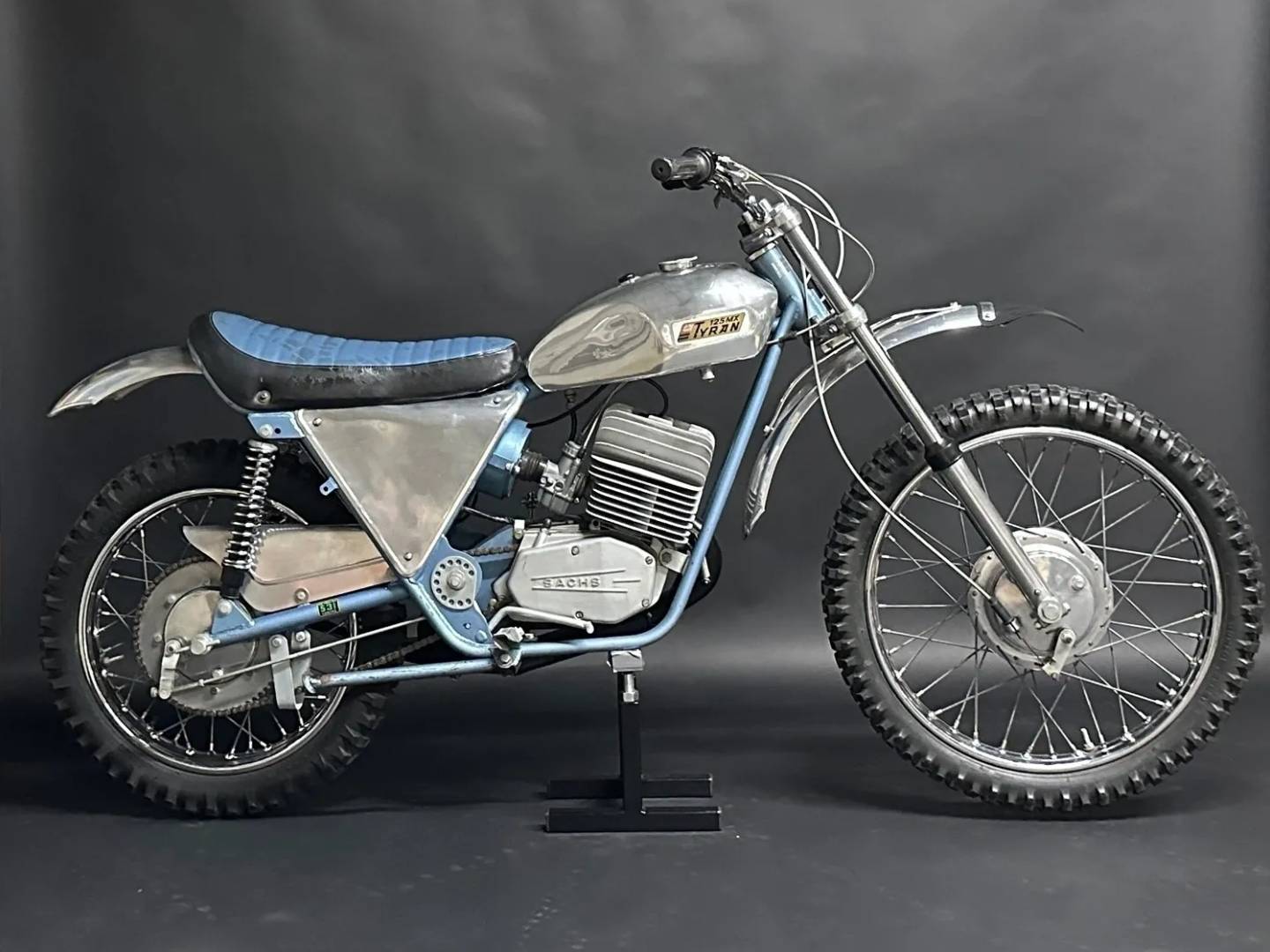
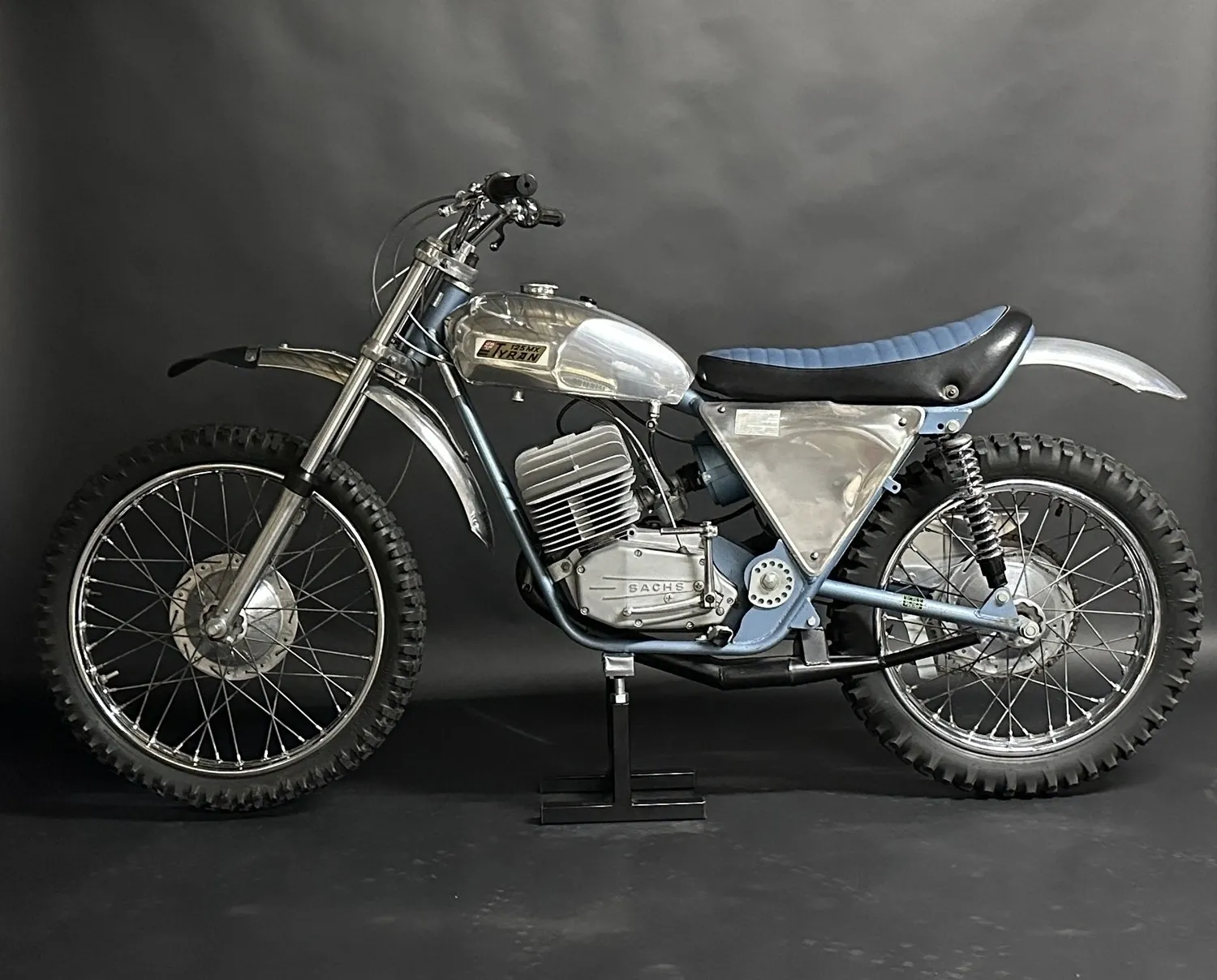
This 6-speed engine featured an aluminum alloy cylinder and radial finned head. To further enhance cooling, fins were cast into the bottom of the cases. Interestingly, in an “Ask E.C.” feature from Cycle News, E.C. Birt (more on him later) advised a reader to cut off all the fins on the bottom of the cases and grind them smooth because they did little to help cooling and instead only added weight and collected mud. Wassell decided to utilize a down pipe on the Tyran, likely because routing was easier. The expansion chamber cones under the frame were flattened slightly to add ground clearance.
Although removing the side panels and seat are easily accomplished with only a screwdriver allowing access to the low-quality paper air filter, the opening to the air box faced forward, also providing an easy access point for dust, mud or water.
The frame and swingarm were manufactured from Reynolds 531 tubing in a light metallic blue color. The innovative chain adjustment system utilized cams on each side of the swingarm pivot. The tank, fenders, side panels and seat base were all custom Wassell designed aluminum alloy units.
Also, custom was the seat, although its design seemed like an afterthought. Interestingly, it was similar to the Dalesman seat and equally inadequate. Since Peter Edmonson (formerly of Dalesman) was largely in charge of Tyran development, I have to think this was his design. The ridiculously thin foam also contributed to the 31” seat height. Motorcyclist commented that it was horrible and best suited for riders under 5’6”. Because the seat was elevated in the rear (TT style) it pushed riders forward, resulting in all three testers in the MiniCycle Action review to complain about it as well.
The 27mm Bing carb, chain, bars, footpegs, grips, levers, tires and almost everything else were right out of the Wassell catalog. With regard to the old school steel levers, Dirt Rider didn’t like them stating “they make you cringe and count your fingers when you look at them.” The single leading-shoe brakes were also a common point of contention due to the effort required to actuate them; mostly caused by stiff brake return springs and excessively long cables.
Ultimately, with the exception of Dirt Rider, the reviews of the production Tyran weren’t too bad. Motorcyclist stated that the handling and suspension were superb, and Cycle World felt that with a few changes it could be a winning 125.
However, the Japanese brands entered the 125 motocross US market in 1974 creating a very challenging environment for Mitsubishi. At a list price of $943, Tyran pricing was in line with the European brands but significantly higher than the $600 Japanese competition. It wasn’t long before Mitsubishi realized what they were up against. They were attempting to distribute an inferior bike in an intensely competitive American 125 market with a limited dealer network and very few aftermarket performance options available.
To my knowledge, what Mitsubishi did next has never been done before or since. Enter E.C. Birt, a legendary motocross engine modification tuner, specializing in small bore European two-stroke engines. Birt founded Precision Cycle in California and later E.C Distributing in Florida. In fact, a young Donnie Emler got his pipe design experience working for E.C. Birt in California before going on to start the legendary Flying Machine Factory aftermarket company.
Somehow, Birt got in front of Wassell and Mitsubishi in late ’73 and together decided on a completely new approach in an attempt to provide a more competitive bike for the American market. If buyers of new automobiles had the luxury of selecting the options they wanted to personalize it to their needs, why couldn’t they do the same with a motorcycle? Why ship a bike with components that many riders may simply replace or modify if you could get it all at once tailored to your needs at nearly the same price?
The concept was for Mitsubishi to import the Tyran in a partially complete state, giving the consumer the option to create their own personalized P.C. (Precision Cycle) Tyran replica. The dealers would be supplied with E.C. Birt Stage 1, Stage 2 and Stage 3 engine kits to suit the need of the rider. They designated the kits as Stage 1 (Enduro. Junior), Stage 2 (Intermediate or Expert) and Stage 3 (Pro MX, TT & Short Track). Each kit received stage tuned cylinder porting, a machined head, pipe and 28mm carb.
In essence consumers would have three bikes to choose from and an allowance for other options such as: plastic Rahm Engineering tank, fenders and side panels, Boge Mulholland or Aranco shocks ($60), Betor or Ceriani forks, reworked airbox with Filtron air filter, Andres bars ($15) and D.I.D. aluminum rims.
With the exception of Dirt Bike, other magazine tests provided positive reviews. MiniCycle Action stated “It had the most flexible powerband of any 125 two-stroke we’ve ever tested and it’s as fast as all but the best modified Honda’s and Penton’s.” Dirt Rider said “the P.C. Tyran is one heck of a lot better than expected. In fact, it’s top notch.”
While Wassell decided to cease all motorcycle production in 1975, E.C. Birt remained a legend in motocross tuning during this exciting time in the sport’s golden era.
(Note: The Tyran 125 MX in this collection is a stock production model, not a P.C. modified Tyran.)
1974 Tyran 125 MX
This 1974 Tyran 125 MX is 100% original and has had zero restoration. Based on its condition, this bike has low or no hours on it. In 1974 this bike was one of one Tyran 125 MX models that a Canadian dealer could get from the US distributor, which was probably a good thing as it never sold. Ironically, this is the third bike in this collection that originated in a Canadian dealership (the other two were the 1976 CZ 125 Falta and the 1977 Montesa 125 VB).
When the dealership owner passed away, he left three of his motorcycles, including this one to his nephew in Las Vegas. In 1991 the nephew sold the bike to Dave Pingelton a collector of British motorcycles who also happened to have a motorcycle dealership in Kansas City from 1960 – 1979. The new owner never started the bike and ultimately traded it to Danny Selman a friend and fellow motorcycle collector in Pflugerville, TX in the late 1990’s. Danny who first learned to ride on a Triumph, excelled in Triumph restorations winning many motorcycle shows across the country. After receiving the Tyran, Danny never ran it and in January 2015 listed it on eBay.
My good friend and collector Ron Carbaugh had noticed the listing, began bidding on it and called to ask if I was interested in it. Upon realizing the bike was all original and 99% complete, I said yes and Ron ultimately won the auction on 1/27/15. I then acquired the bike from him.
The reason I mentioned above that the bike was 99% complete was because it was missing the front fender. At the time, I thought it should be possible to acquire one, it turns out they are nearly impossible to find. The over-engineered assembly consists of a mount, fender bracket, fender and mud flap. But I got lucky. After receiving the bike from Ron, he suggested I contact Larry Hladki who might be able to steer me in the right direction. When I contacted Larry, he said “I only have one part for a Tyran, and it’s an original front fender complete with the mount, bracket and rubber mud flap”. Who knows how long it would have taken to find an original Tyran fender assembly, if ever, but thanks to Larry the Tyran was now complete.
Thankfully, the original Canadian dealer never sold this bike, and the subsequent owners never rode it and kept it stored indoors within their own collections. Consequently, everyone can now see what a 1974 Tyran 125 MX looked like sitting on the dealership floor over 50 years ago.